An AI Wrote About AI's Death. Nobody Checked.
A fact-check of the "AI Moats are Dead" article — and what it reveals about AI-generated content


A Substack post making the rounds argues that AI models have no moat. The thesis is right. The execution is the real story.
“Why AI Moats are Dead” by Farida Khalaf argues that Clawbot (now OpenClaw), an open-source project from Peter Steinberger of PSPDFKit, proved AI models are interchangeable commodities. Clawbot treats Claude, GPT, and DeepSeek as swappable backends. Orchestration matters. The model doesn’t. Within days, both Anthropic and OpenAI shipped competitive features: Cowork plugins and GPT-5.3-Codex. The article frames this as a panic response.
That’s a real story. But the article was clearly generated by the tools it’s writing about. The formatting is inconsistent. The embedded video has errors nobody caught and looks like it was dropped in without a human checking whether it supports the argument. The whole thing reads like someone prompted “write me a market analysis of AI commoditization” and hit publish.
Which makes it the best possible evidence for a point the author didn’t intend to make.
The Actual Moat
The commoditization argument is correct, and it’s not new. Anyone building on top of LLMs figured this out months ago. I run an AI-powered search agent at work. The model underneath has changed three times. The results barely moved. What matters is the orchestration — the context layer, the domain knowledge, the tool integrations, the workflow design.
Clawbot proved this publicly. But the lesson isn’t “AI labs are doomed.” It’s that the model is infrastructure, not product.
The same way nobody cares which cloud provider runs their SaaS app, nobody will care which LLM runs their AI features. AWS doesn’t have a moat because of its servers. It has a moat because of the ecosystem built on top of them. Same principle applies here.
What the AI-Generated Article Got Wrong
The article’s headline argument — models are commodities — holds up. The evidence it uses to get there doesn’t.
It invented causation from a timeline. The article’s central narrative: Clawbot went viral January 27, Anthropic “panic-shipped” Cowork plugins January 30, OpenAI rushed out GPT-5.2-Codex February 5. Three days! Panic! Except the article got the model name wrong — what launched February 5 was GPT-5.3-Codex, not 5.2. GPT-5.2-Codex had already shipped on January 14, two weeks before Clawbot went viral. And enterprise features don’t ship in 72 hours — Anthropic open-sourced 11 specialized plugins across legal, finance, marketing, sales, and more. That’s months of development, not a weekend scramble. No credible tech outlet — not TechCrunch, not Bloomberg, not The Verge — framed either launch as a panic response to Clawbot. That narrative is the article’s own invention.
It blamed the wrong thing for the selloff. The article attributes the February tech selloff to Clawbot proving AI commoditization. Bloomberg, Fortune, and CNBC all attribute it to Anthropic’s Cowork legal automation plugin and the subsequent Claude Opus 4.6 release — investors spooked about AI replacing IT services work, not open-source agents proving model interchangeability. RELX (LexisNexis’s parent) crashed 13% because Anthropic came for legal workflows. TCS and Infosys dropped because clients might need fewer developers. The Nifty IT index fell 19% over eight trading sessions — its worst stretch since the 2008 crisis. None of this was about Clawbot.
It used stale financials to build an IPO doom narrative. The article cites Anthropic’s $183B valuation and projects a 40-60% IPO haircut to $100-120B. By the time the article published on February 7th, Anthropic’s term sheet was already at $350B — and four days later the round closed at $380B, more than double the $183B figure the article treats as current. The article also frames Anthropic’s 2028 target as “profitability delayed to 2028” — inverting what Anthropic’s own internal projections describe as $70B revenue and $17B positive free cash flow (though these are the company’s most optimistic forecasts, not independent estimates).
The OpenAI cash burn figures — $14B for 2026, $115B through 2029 — are real, sourced from The Information via internal projections. But the article presents them without context: OpenAI’s ARR tripled to $20B in 2025, and the company is currently raising at $850B+. The doom framing requires ignoring the revenue side of the ledger.
It conflated protocols. The article references an “AGENTS.md standard” in a context where it means MCP. These are different things. MCP (Model Context Protocol) is a runtime protocol — created by Anthropic — that lets AI agents connect to external tools and data sources. AGENTS.md is a static file convention — created by OpenAI — that gives coding agents project-specific instructions. Both were donated to the Linux Foundation’s Agentic AI Foundation on the same day (December 9, 2025), which explains the confusion. But they’re as different as HTTP is from a README file. Mixing them up suggests the article was pattern-matching AI terminology rather than understanding the technical landscape.
And then there’s the video.
The article includes a 7-second animated explainer. Seven seconds. It auto-plays, blasts through three scenes, and ends abruptly. No human could parse it at speed. But pause it and look at the frames:
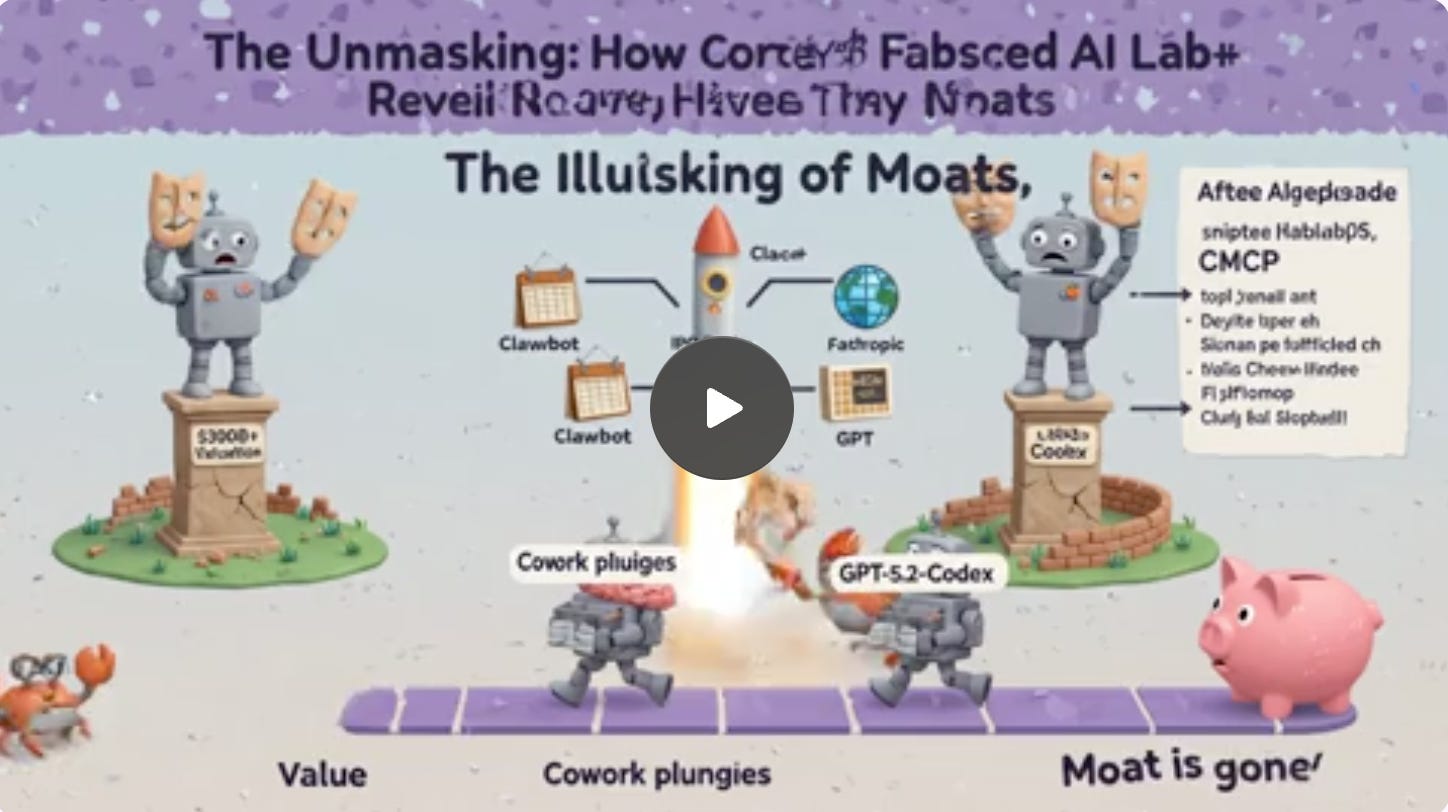
The title reads “The Illuisking of Moats.” Anthropic is labeled “Fathropic” in one frame and “Antropic” in another. Claude becomes “Clac#.” OpenAI becomes “OpenAll.” There’s a company called “Exterropic.” Cowork plugins is rendered as “Cowork pluiges” and “Cowork plungies” — two different misspellings in the same video. A notepad graphic contains what appears to be English from a parallel universe: “Aftee Algeplsade / sniptee Hablabp5, CMCP / topl Jenell ant / Cluly fol Slopball!”
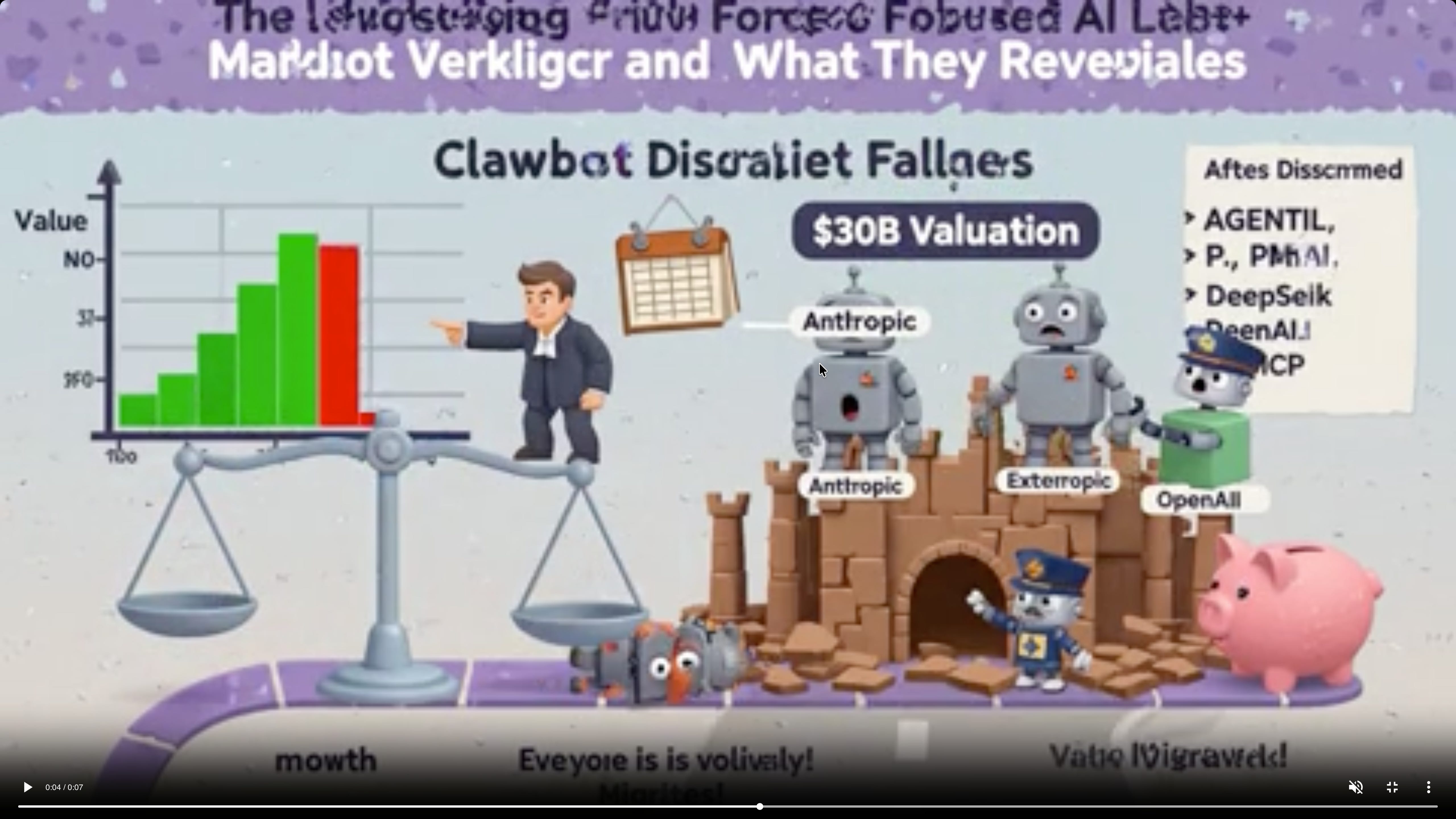
The chart in frame two has a Y-axis labeled “NO”, “37”, “3FO”, and “100.” The valuation callout reads “$30B” — the article’s own headline claims $300B. The bottom captions say “mowth,” “Eveyone is is volivaly! Miaritos!” and “Vahe Migrawed!”
The final frame — the only one with legible text — reads “The Masks Are Gone” over a landscape of bewildered robots standing on crumbling pedestals while rockets launch in the background. It’s AI slop clip art with the production values of a screen saver.
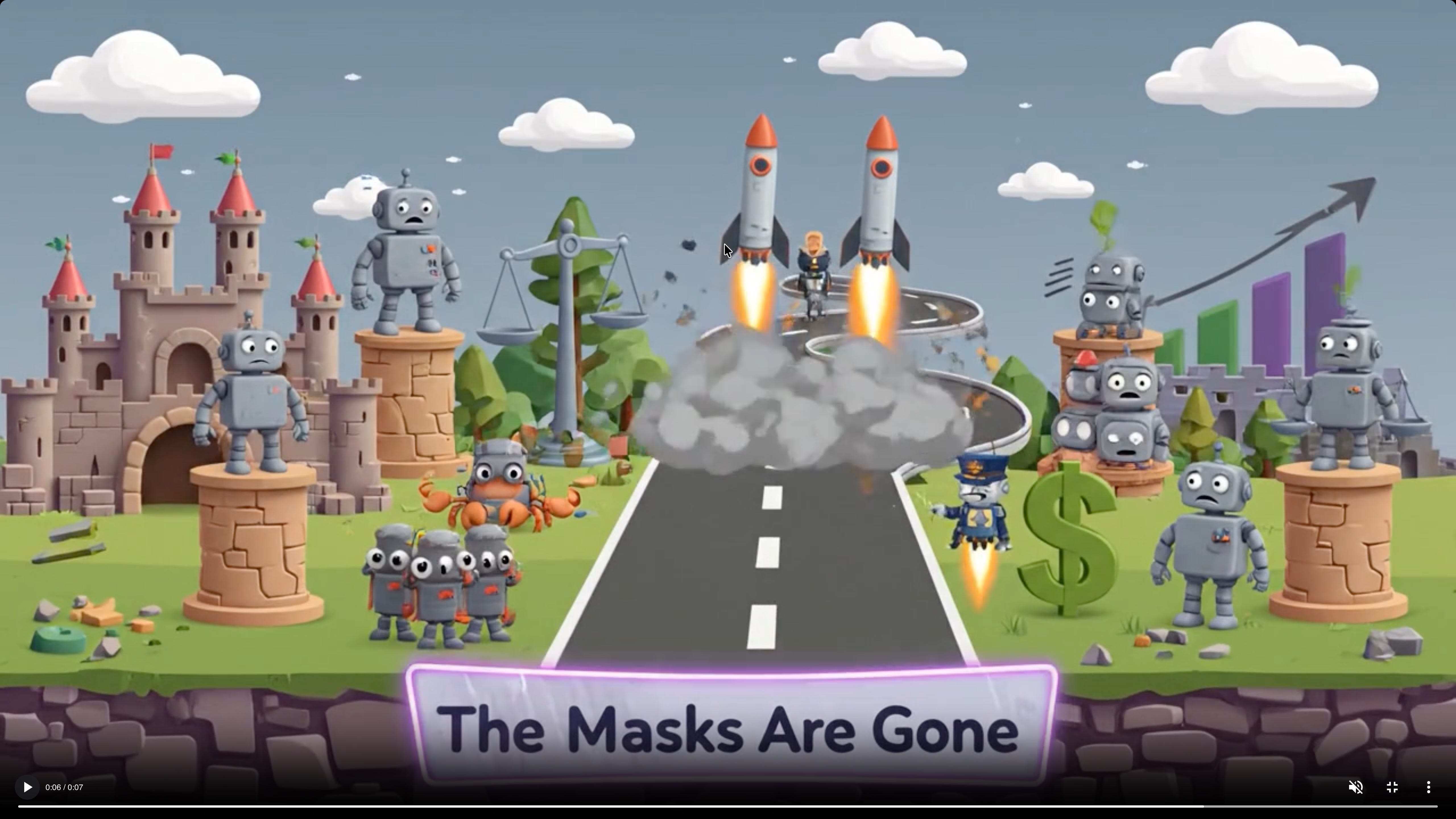
Nobody watched this before publishing. Nobody paused it, read the text, and asked “does Cluly fol Slopball communicate our argument?” The video exists because the AI-to-publish pipeline included a “generate video” step, and the output went live without a single human checking whether it made sense.
This is what AI-generated analysis looks like when nobody checks the work. Each claim is individually plausible. The financial language sounds right. The narrative structure is clean. But the pieces don’t actually fit together, and a human with domain knowledge catches it in minutes. The models assembled a convincing shape of market analysis without verifying whether the facts support the story.
The Uncomfortable Middle Ground
The AI hype cycle wants everything to be binary. Either AI replaces everyone, or it’s a toy. Neither is true.
The reality is boring and useful: AI is a speed multiplier that requires human judgment on both ends. You need judgment on the input side (what context to provide, what question to ask, what constraints to set) and judgment on the output side (is this right, does this serve the argument, should this ship).
I use AI every day for product work — drafting specs, synthesizing meeting notes, building prototypes. The AI has access to my local notes, my project context, my previous decisions. It’s deeply integrated. And I still read every output before it ships. Not because the tools are bad, but because judgment is the whole job. The AI is fast. I decide whether fast was also right.
The Khalaf article skipped that step. And ironically, that’s the same mistake the AI labs are making at scale — shipping capabilities without the editorial layer that makes them useful.
The Real Takeaway
Models are commodities. The article got that right. But the moat isn't in the orchestration layer either — OpenClaw made that open by design, and 145,000 GitHub stars later, the pattern is everywhere.
The moat is the human who knows what to build, what to ship, and what to kill. The person who reads the AI output and says “this isn’t ready” instead of hitting publish.
That’s not a comfortable answer for a market that wants to automate everything. But it’s the one that keeps holding up.
I used AI tools throughout the research and drafting of this piece. Every claim was verified against primary sources. Every sentence was reviewed before publishing. That's the point.