Everyone Can Build Now
Building got cheap. What sits underneath it didn't.

Mo Gawdat, former Chief Business Officer at Google X, went on a podcast a few months back, and I haven’t been able to shake what he said. He built his latest AI startup in six weeks — a build he says would have taken four years and 350 engineers in 2022. One person, some spare time, an AI subscription, doing what a company used to do. His read: “everyone now has a chance.”
He’s right about the speed and wrong about what it means.
And he says it deadpan — the same measured voice he uses for the rest of the podcast. Which is the problem, because the rest of the podcast is the apocalypse: more than a decade of what he calls “hell before heaven,” seven dimensions of coming dystopia he’s branded, and I promise I’m not making this up, “FACE RIP.” Then it all resolves, somehow, into “a utopia that’s biblical in nature.” Heaven, but you have to survive the tribulation first. I’m not going to litigate the cosmology; watch the full sermon if that’s your thing. The part worth keeping is that building got fast, and you can keep that without buying the rapture stapled to it.
Everyone can build now; that part’s true. It’s what people make of it that gets sold two ways:
The optimist says the barrier’s gone, we’re all entrepreneurs, go get rich. The doomer says your software is dead, the model eats the app, some kid clones your whole business over a weekend. Opposite moods with the same blind spot. If anyone can build the thing in a weekend, then building was never the part that mattered — a fact the people monetizing your panic and the people monetizing your FOMO would both rather you skip past.
What actually got cheap
Construction is what collapsed. The model assembles the application now — the interface, the wiring, the boilerplate that used to eat the first months of any project — and hands back a working surface. Not a shippable one; the hardening and edge cases and security pass still fall to a person. But even discounting for that, the collapse is real. Building genuinely got faster. The part he skips is that all that speed bought him was a wrapper, and the wrapper was always the cheap part.
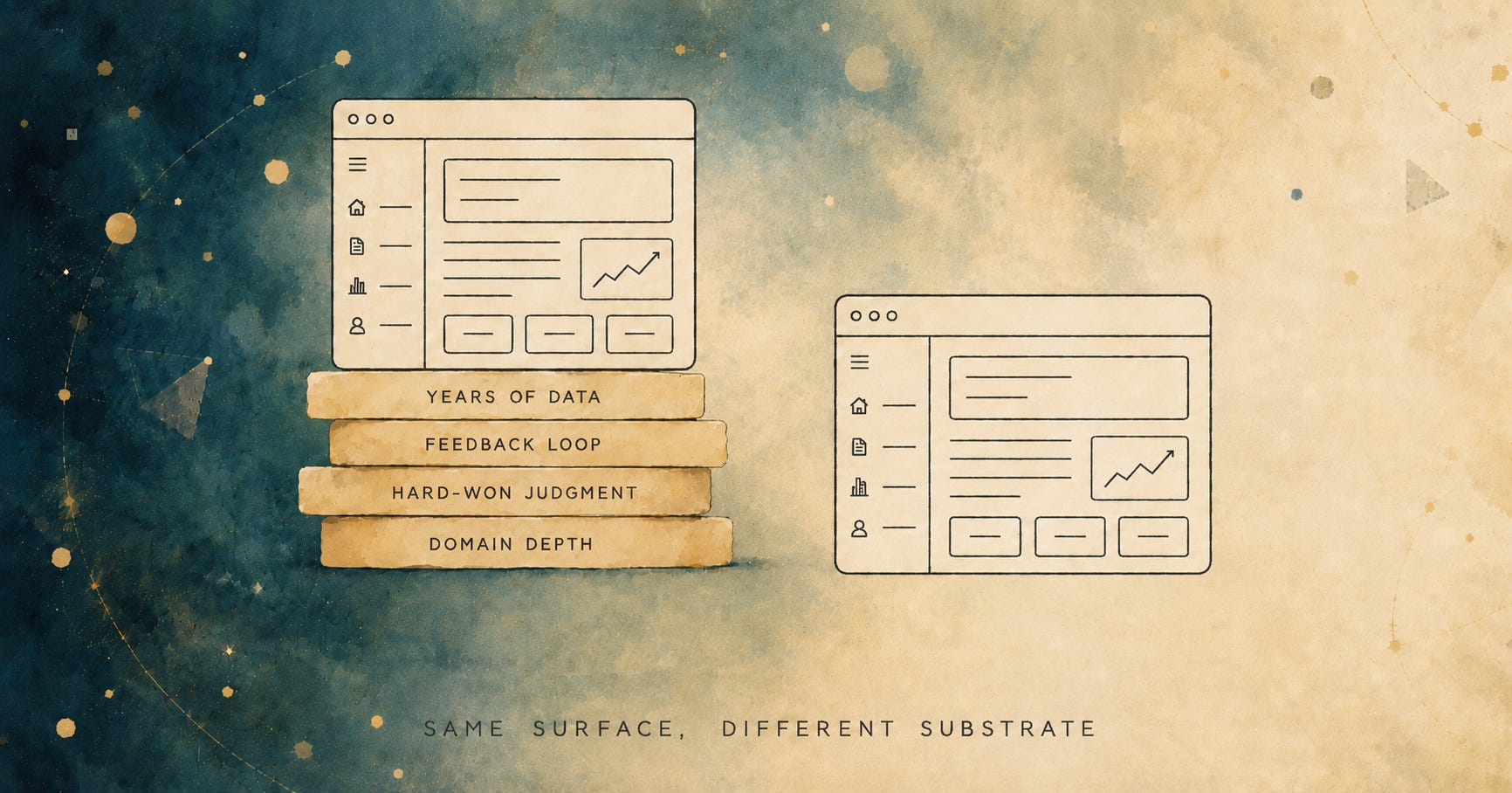
Everything the wrapper sits on top of is where the cost actually lived. The data you fed it. The years of watching what people did with the thing and adjusting. The defaults you got right because you’d gotten them wrong a few times first. You could always have paid someone to build the surface; the only thing that changed is the price. The layer underneath was never for sale at any price, because it isn’t the kind of thing you buy.
Siddharth Vader argues the app layer is dead — that the wrapper around a model is disposable, and only what it wraps survives the next model release. Gawdat’s startup is that same argument told as a victory lap: the wrapper got cheap, which is exactly what anyone building on top of a model should have expected.
The same force cuts both ways
The exact capability that made building free is what makes everything upstream of it scarce. When execution drops to zero, the constraint doesn’t vanish; it moves. It moves to the things you can’t generate on demand: data collected over years, a feedback loop that’s run long enough to say something true, domain depth curated by someone who knew what was worth keeping, distribution, the relationships that took as long to build as everything else.
A better model compresses construction. It does not compress the calendar.
You cannot prompt your way to five years of usage data, and no version of the model, however good, hands back the time you didn’t spend.
What a weekend can’t clone
Take any product with real history behind it — a search tool, a recommendation engine, a support system that’s been answering the same questions for ten years. A competitor rebuilds the surface over a weekend. Same screens, same buttons, a search box that looks identical to yours.
Then they switch it on and it’s empty. No click data telling it which of ten reasonable results people actually wanted. No record of the queries that returned nothing — which is exactly where the learning hides. None of the thousand small corrections that happened because someone watched the thing fail and stayed late to fix it. A weekend buys the surface. What it can’t buy is ten years of being wrong in specific, documented, corrected ways.
Counterarguments, compressed
The model will eat the data too. Sure — on the stuff that makes the model itself smarter: coding, reasoning, the things the labs already pour billions into. But your niche? Nobody in San Francisco is losing sleep over it. Winning your little vertical doesn’t move a frontier lab’s number, so they’ll never go collect the data that would. And the well-funded competitor who tries to shortcut it with synthetic data hits the same wall. You can generate a plausible question, but you can’t generate ten years of real people being wrong in ways nobody predicted, which is the only data that ever tuned the thing. That data exists because the years passed while you were collecting it.
This is just “data is the new oil” in a new coat of paint. It’s a narrower claim than that. The oil line says data is valuable in the abstract. The point here is about timing: the thing that just got cheap was always something you could buy, and the thing left standing is the one thing you never could.
Cheap building helps your competitors too. True, but only for the building. Anyone can clone your surface by Sunday; the five years underneath it, they’d still have to spend.
What you actually own
I’ve argued before that the models are commodities, and that your AI tool is a service — the model’s a rental you don’t control, and the durable part is whatever you build around it. Everyone can build now. Take away the model you’re renting and the app you can regenerate over a weekend, and what’s left standing is the part that took actual time: the inputs you accumulated, the loop you kept running, the judgment that froze into all of it one hard decision at a time. If you’ve got years of that behind you, the move is to stop underrating it; it’s the one asset a competitor can’t speed-run in a weekend.
Which is the turn both the optimist and the doomer miss. “Everyone can build now” was never a threat to a business sitting on those inputs; it’s the argument for owning them. Everyone can build now. That’s the whole reason building stopped being the thing worth having.
One last thing about heaven
Sorry, but I can’t let that utopia pitch slide. Every version of “everyone can build now” runs the same script: a decade-plus of hell first, fine, mass unemployment, capitalism “redefined,” but paradise on the far side, “trust us bro.” It’s the oldest move there is: promise heaven later so nobody counts who’s getting rich right now.
Walk Gawdat’s own timeline. The platform owners get powerful enough to “redefine humanity,” then balk at funding the universal basic income that keeps everyone else fed, and then those same owners hand the winnings back out of the goodness of their hearts and we all arrive somewhere biblical. The dystopia he describes is just capitalism running as designed. The utopia needs the people winning that game to voluntarily stop playing it. Asked point-blank whether he thinks that happens, he says: “I don’t. No.”
So he’s got a decade of engineered suffering, no mechanism out the other side, and a confident prediction of paradise all the same. It’s a prayer he’s selling as a forecast — build the thing that eats the jobs, sell heaven to the people it ate, and charge admission to the salvation.
Anyway… own your inputs.
It’s the one part of this whole story nobody gets to promise away.